Inspired
From 25,000 mph to Splashdown: How the Artemis II Crew Landed Back on Earth
NASA’s Artemis II mission successfully concluded on 10 April 2026, as astronauts Reid Wiseman, Victor Glover, Christina Koch, and Jeremy Hansen landed in the Pacific Ocean. The return involved a high-velocity atmospheric re-entry at 25,000 mph, a critical six-minute communication blackout, and a precision recovery operation by the USS John P. Murtha.

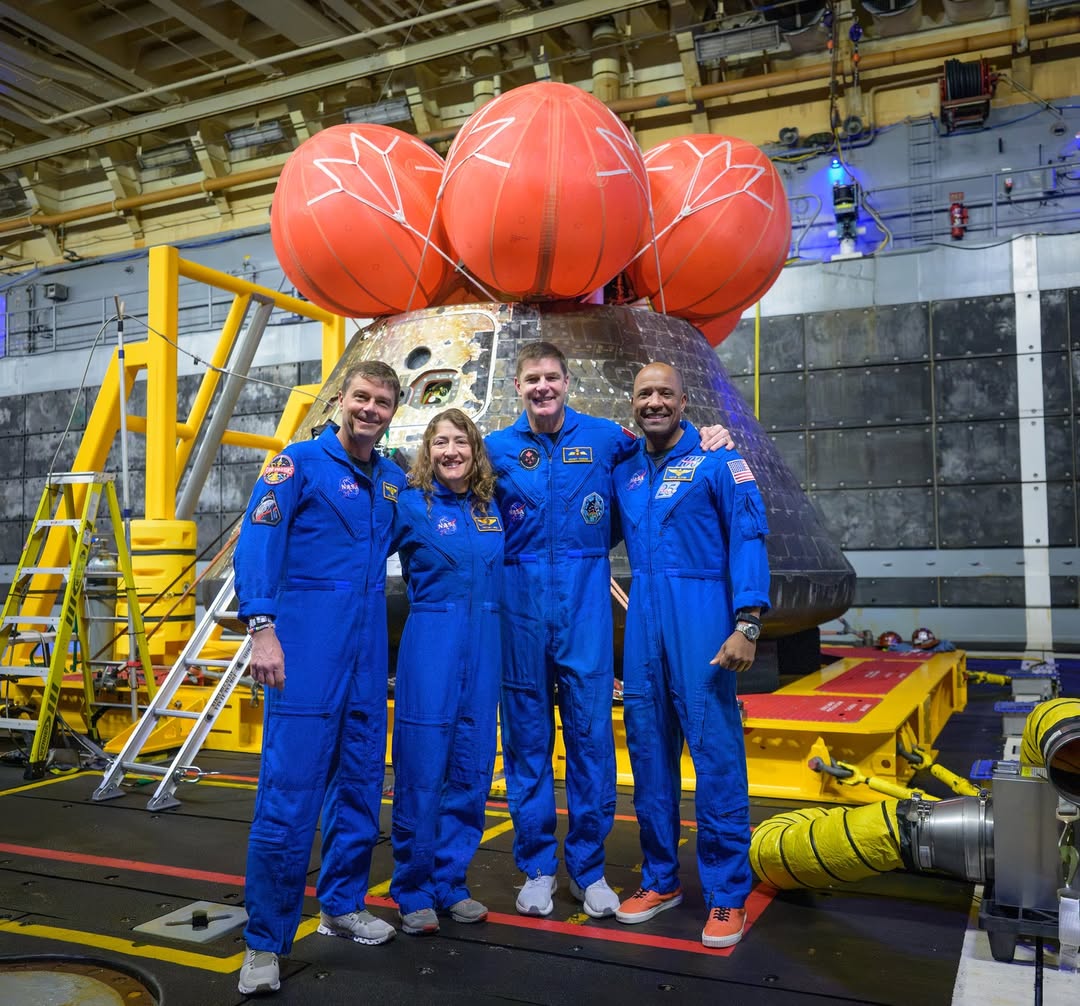
The four Artemis II astronauts—Reid Wiseman, Christina Koch, Jeremy Hansen, and Victor Glover—pose in blue flight suits in front of the Orion capsule in the well deck of the USS John P. Murtha. Photo Credit: NASA/Instagram
They went to the Moon and came back. But getting home from space is not as simple as it sounds. The story of how the Artemis II crew landed back on Earth on 10 April 2026 is one of the most fascinating things you will read today. Strap in.
First, a quick recap
The Artemis II mission launched on 1 April 2026, sending four astronauts — NASA’s Reid Wiseman, Victor Glover, and Christina Koch, along with Canadian Space Agency astronaut Jeremy Hansen — on a nearly ten-day journey around the Moon aboard the Orion spacecraft, which the crew named Integrity. During their journey, the crew set a record for the farthest distance humans have ever travelled from Earth — 252,756 miles, reached on 6 April. But getting back home from that distance is a whole story in itself.
So, how do you actually get home from the Moon?
Before you can splash down in the ocean, you first have to point yourself back toward Earth. The Artemis II crew began the final phase of their journey by preparing for a series of return trajectory correction burns — precise engine firings designed to keep Orion locked onto the exact path needed for a safe re-entry. Think of it like adjusting the aim of an arrow mid-flight, except the arrow is travelling at tens of thousands of miles per hour, and any miscalculation has serious consequences.
The crew woke up on their final day in space 61,326 miles from Earth. By the time the day was done, they would be home.
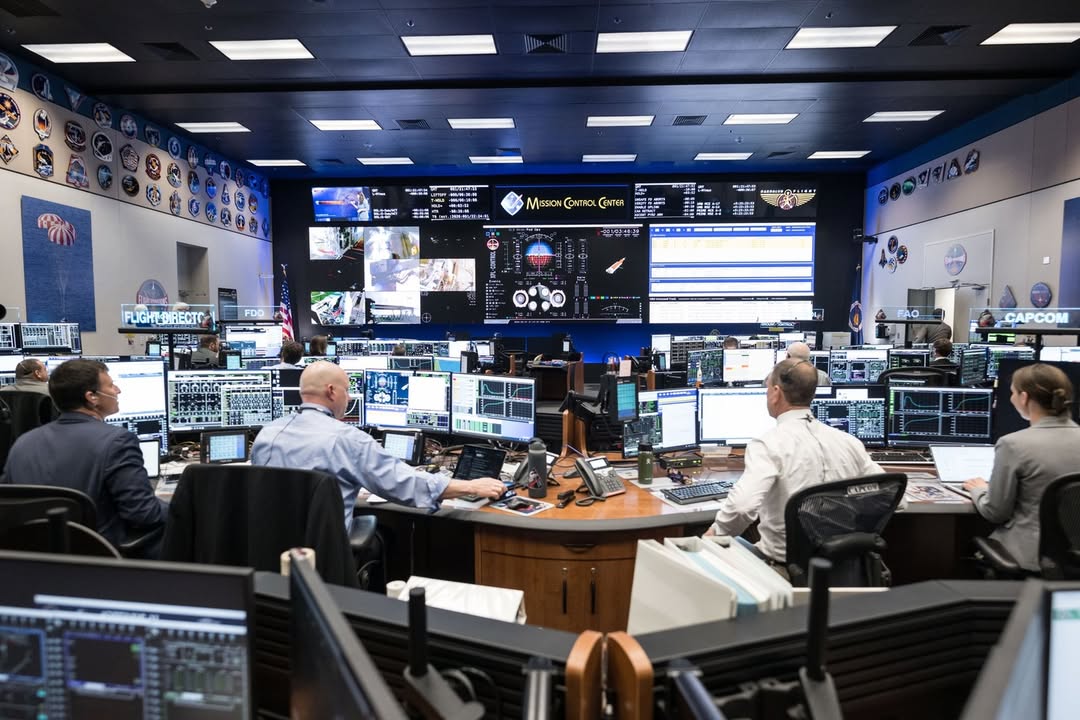
A view inside NASA’s Mission Control Center in Houston during the Artemis II re-entry, showing flight controllers at desks with multiple data screens. Photo Credit: NASA/Instagram
The part that had everyone holding their breath
Here is where things become truly extraordinary. Returning from the Moon is not the same as returning from the International Space Station. The spacecraft is travelling much faster and hits the atmosphere at a far more intense angle, which means the heat it generates is in a completely different category.
The Orion spacecraft reached Earth’s atmosphere 400,000 feet above the planet’s surface, travelling 35 times the speed of sound. Let that sit for a moment. Thirty-five times the speed of sound. Re-entry is particularly risky because spacecraft can be exposed to temperatures of up to 5,000 degrees Fahrenheit, hotter than anything we experience on Earth’s surface.
To survive this, Orion is fitted with a heat shield, a specially designed protective layer on the base of the capsule that absorbs and deflects that extreme heat. This was especially significant for Artemis II because Orion’s heat shield had known design flaws identified during the Artemis I uncrewed mission, making re-entry one of the most closely watched moments of the entire flight. In the end, it held. The crew came through safely.
Six minutes of complete silence
One of the most nerve-wracking parts of the entire process is something called the communications blackout. As Orion descended through about 400,000 feet, the spacecraft entered a planned six-minute blackout as plasma formed around the capsule during peak heating.
What this means is that as the spacecraft hit the atmosphere, the intense heat created a layer of charged particles — plasma — around the capsule, completely blocking all radio signals. For those six minutes, Mission Control in Houston could not hear from the crew, and the crew could not hear from Mission Control. Everyone simply had to wait.
When the signal finally returned, it confirmed what everyone was hoping for. The crew was safe.
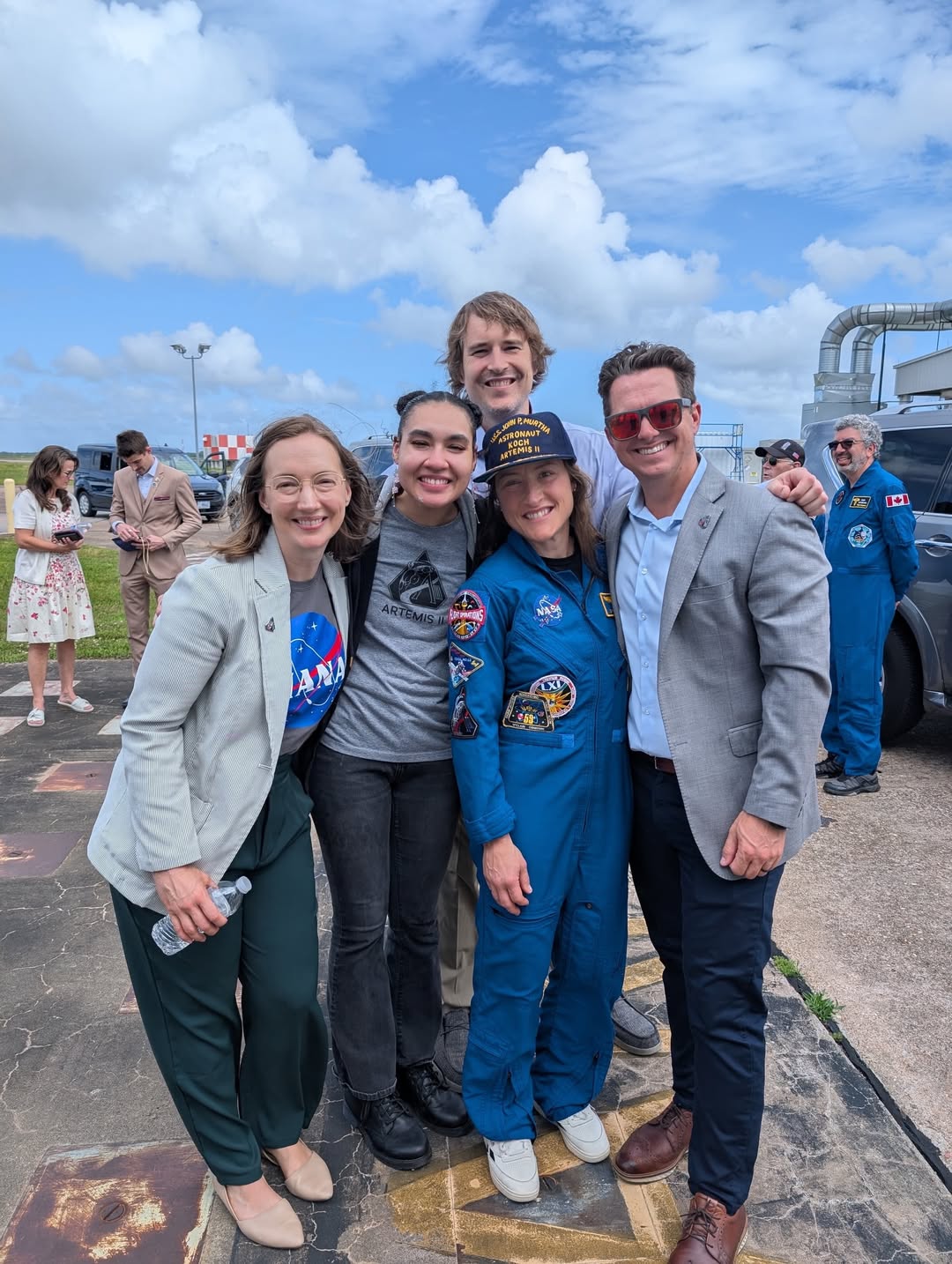
NASA astronaut Christina Koch celebrating with members of the Johnson Space Center recovery team after the Artemis II mission. Photo Credit: NASA/Instagram
From 25,000 miles per hour to 20 — the parachutes that made it possible
Once through the worst of re-entry, the spacecraft still needed to slow down from hundreds of miles per hour to something safe enough to land in water. NASA deployed a carefully timed sequence of parachutes to make this happen: first, two drogue parachutes to slow the capsule to about 307 miles per hour, followed by three pilot parachutes that pulled out the three main parachutes, which then completed the final slowdown.
The capsule’s three main parachutes slowed it to around 20 miles per hour just before splashdown. From 25,000 miles per hour at re-entry to 20 miles per hour at the water. That is the parachute system doing its job perfectly.
The moment Mission Control called a perfect bullseye
At exactly 8:07 p.m. ET on 10 April 2026, the Orion capsule splashed down in the Pacific Ocean, about 40 to 50 miles off the coast of San Diego, California. Mission Control called it immediately: “This is a perfect bullseye splashdown.” NASA commentator Rob Navias added: “This is a perfect descent for Integrity. Its crew sounding hale and hearty on board.”
The final mission numbers captured just how remarkable the journey had been. Entry Flight Director Rick Henfling said at the post-splashdown news conference: “Integrity and her crew of four astronauts flew 700,237 miles, we reached a peak velocity of 24,664 miles per hour, we hit our flight path angle target within 0.4%, we flew an entry range of 1,957 miles, and we landed within less than a mile of our target.”
Getting the crew out
Landing in the ocean is only the beginning of the recovery process. The capsule does not simply dock at a pier. U.S. military and NASA personnel approached Orion in inflatable boats following splashdown, with Navy divers attaching a cable, called the winch line, to pull the spacecraft into a specially designed cradle inside the USS John P. Murtha’s well deck.
Before the astronauts could even step out, Navy divers deployed a large inflatable raft known as the “front porch” outside the capsule. This gave the crew a chance to regain their balance and begin readjusting to Earth’s gravity. After ten days in microgravity, even standing upright becomes a challenge.
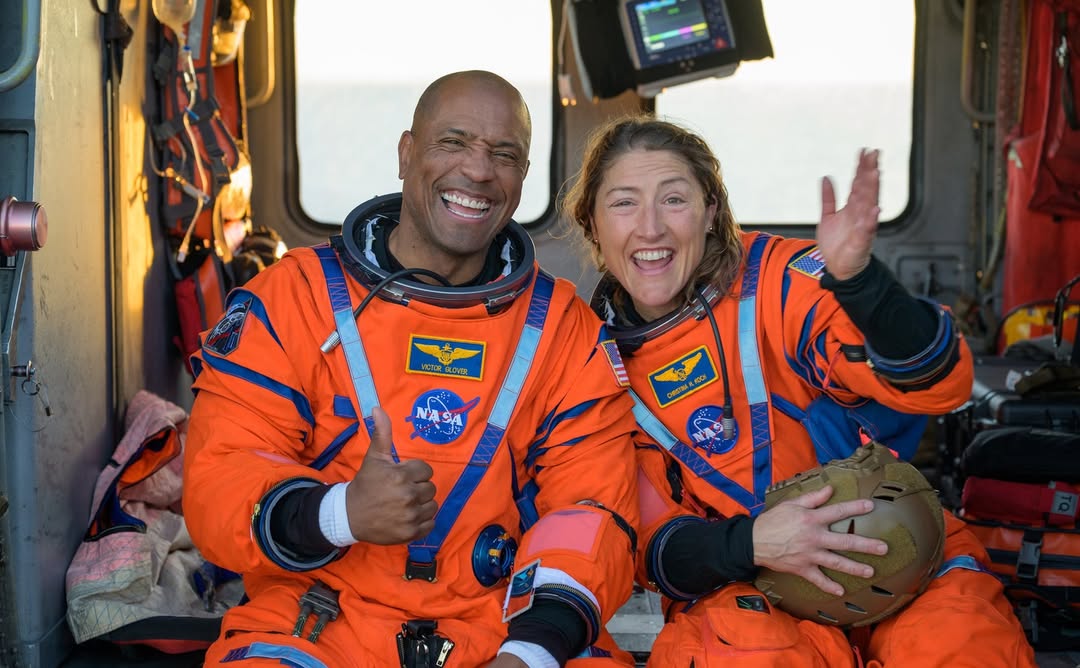
NASA astronauts Victor Glover and Christina Koch smiling inside a Navy MH-60 Seahawk helicopter on the flight deck of the USS John P. Murtha. Photo Credit: NASA/Instagram
NASA’s Artemis II landing and recovery director Liliana Villarreal said that before anyone outside had even seen the crew, she watched video of them inside the capsule and they were already in high spirits. “Everybody was doing very well, and they were just having such a great time with the medical team that was inside the capsule. I think they were all taking selfies,” she said. “And then we put them on the front porch and again, you could see they were just so ecstatic to be home and talking to everybody.”
The crew were then individually hoisted into waiting helicopters and flown to the flight deck of the USS John P. Murtha, positioned about 2,000 yards from the Orion capsule.
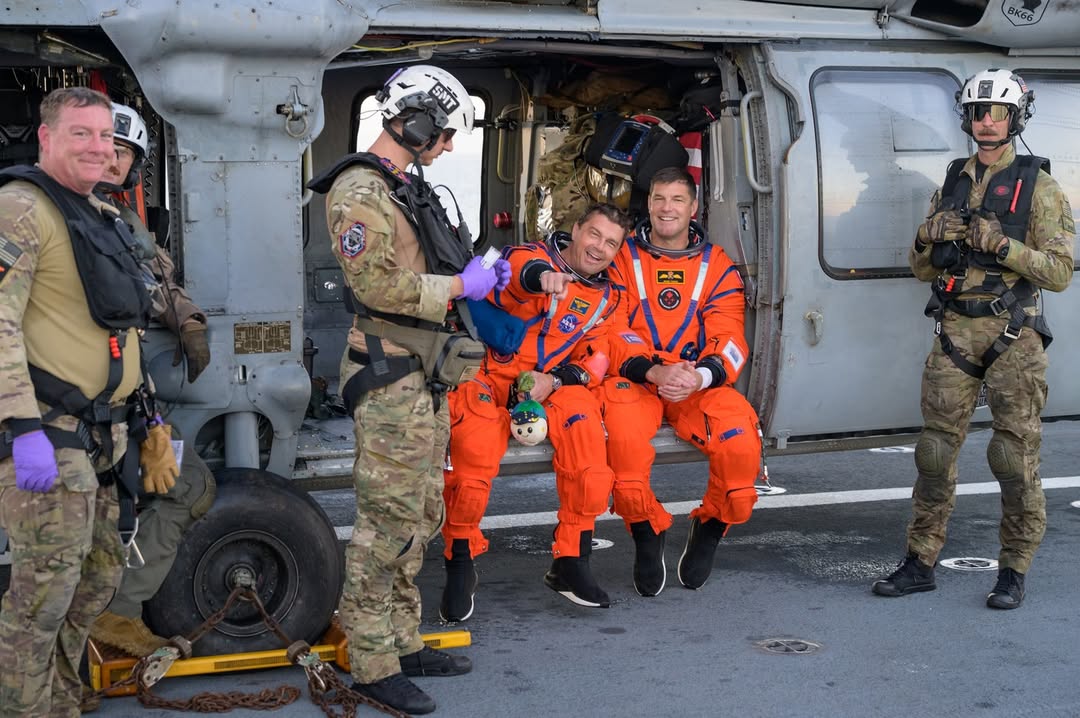
Artemis II commander Reid Wiseman and CSA astronaut Jeremy Hansen sitting on a Navy MH-60 Seahawk helicopter after being hoisted from the Pacific Ocean. Photo Credit: NASA/Instagram
What happens after you land from the Moon
Landing is not the end of the process, not even close. Once aboard the recovery ship, the astronauts underwent medical evaluations and were scheduled to complete post-landing functional tests, including an obstacle course and a simulated spacewalk, to assess how quickly they could readapt to gravity.
The human body changes significantly in space — muscles weaken, bones lose density, and the cardiovascular system adapts to a world without gravity. Coming back to Earth is a physical adjustment that takes time.
Before suiting up for re-entry, the crew had also worn compression clothing known as orthostatic intolerance garments, designed to help their bodies manage the return to gravity and reduce symptoms like dizziness and lightheadedness.
From there, the crew were flown back to NASA Johnson Space Center in Houston, where their families were waiting.
The four Artemis II astronauts—Reid Wiseman, Christina Koch, Jeremy Hansen, and Victor Glover—pose in blue flight suits in front of the Orion capsule in the well deck of the USS John P. Murtha. Photo Credit: NASA/Instagram
Why any of this matters
NASA’s broader goal is to land astronauts on the lunar surface in 2028, setting the stage to build a base there and establish a long-term presence on the Moon. Artemis II was the test flight that proved the system works — the rocket, the spacecraft, the re-entry, the recovery, all of it. Four people went further from Earth than any humans had gone in more than fifty years, and they came back safely.