Features
Israel Olaleye: How Can Young Nigerians Buy Land & Properties Legitimately Today?

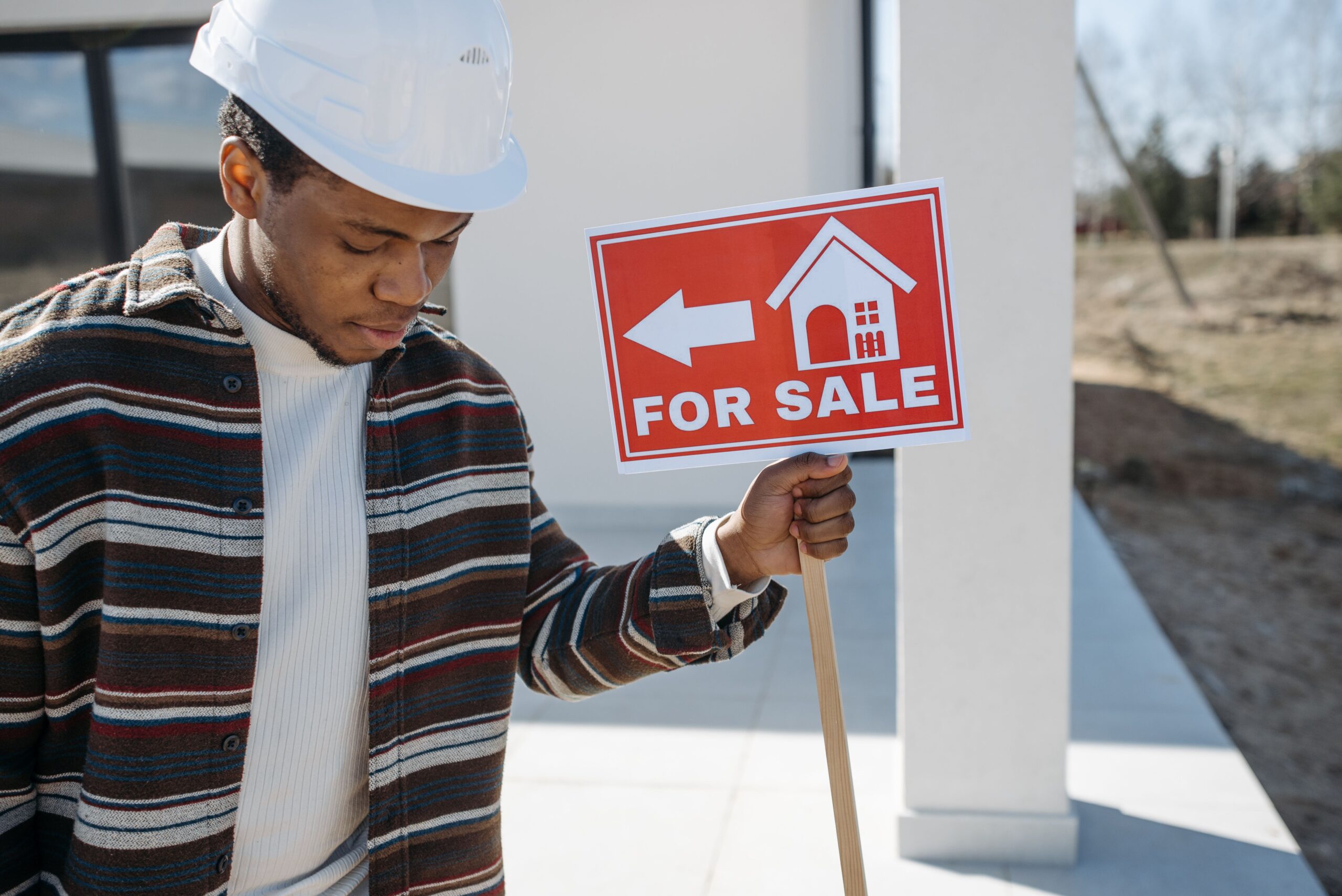
Young man with a hard hat holding a red for sale sign outside a building by Pavel Danilyuk for Pexels.
My parents’ generation mostly bought land the way their parents did. Someone in the family knew someone in the village. An uncle walked the boundaries. The community remembered who owned what, and if anything went wrong, you had a face to go back to.
However, my generation buys land on Instagram.
I do not say that to mock anyone. I sell land for a living. When I started in real estate sales in 2023, two years after finishing a Mathematics degree at the University of Ibadan, I assumed buyers would care most about price and location. They do care. But what I hear most often is fear, dressed up as questions.
Can I trust you? Is this land real? What happens if I miss a payment? After I pay, will someone come and ask me for more money?
A prospective buyer once asked me, before anything else, whether community or family payments would follow after she paid for her plot. She was not asking about the land. She was asking whether the price I quoted was the real price.
She had good reason to ask. Lagos State’s Property Protection Law of 2016 made it an offence to demand levies for construction on someone else’s property. Yet the same law still allows a land-owning family, with the family head’s authority, to collect a customary fee for possession, the payment many people know as a “foundation levy”. So the honest answer to her question is not a simple yes or no. It depends on the land, the family, and what has been written down. Most first-time buyers have never been told any of this.
That is the gap I keep coming back to. Nobody taught us how to buy land.
We learned how to save. Some of us learned how to invest in stocks, crypto or a side business. But land, the asset our parents spoke about with the most respect, has no manual. The people who used to stand in for the manual–the uncle, the community, the family lawyer everyone trusted–are often not part of how we buy anymore.
So we improvise. A prospect once told me she had gone through my Instagram page carefully before she agreed to speak with me. She was checking whether I was consistent, whether my posts matched what I said on the phone, whether I had been around long enough to be real. I was flattered. Then I was worried. Because if a social media page has become part of a buyer’s due diligence, then a polished page has also become one of the easiest ways to deceive her.
Instagram cannot tell you who owns a piece of land. Only a search at the land registry, done by your own lawyer, can begin to tell you that. Instagram cannot tell you whether a plot sits under government acquisition or on a planned road. A surveyor who charts the coordinates and checks them against official maps can. No number of testimonials replaces a written contract that states what you are paying for, what you are not paying for, and what happens if a payment is missed.
None of this is complicated. It is just not taught.
The irony is that my generation may need this knowledge more than any before us. We are buying earlier, often on instalment plans, often far from where we live. Many of us are buying from abroad, relying on a cousin’s video call and a WhatsApp voice note. We are also buying in places our parents may never have considered. Ogun State, for example. In the most recent quarterly report from Nigeria Property Centre, rental listings in Ogun drew roughly three times as many enquiries per listing as those in Lagos. People priced out of Lagos are already living there. Young buyers have noticed, and so have people who would happily sell them land that does not exist.
I have come to believe that the most valuable thing a real estate professional can offer is not a property. It is clarity. I have seen buyers relax, visibly, when someone finally explains the difference between a Certificate of Occupancy and a survey plan, or tells them plainly which fees are coming and which are not. I have also seen people who were afraid to invest for years finally do it, not because they were persuaded, but because they understood.
If you are about to buy your first piece of land, here is what I wish someone sits my generation down to say.
Don’t let anyone’s confidence replace your own checks. Get your own lawyer to search the title. Get a surveyor to chart the land. Ask, in writing, what the price includes and what it does not, including any family or community fee. Ask what happens to your money if you cannot complete an instalment plan. And verify the person you are dealing with, including people like me.
Our parents had communities that remembered. We have screenshots, receipts and group chats. That can work, but only if we learn to ask the questions our parents never had to. Nobody taught us how to buy land. We can still teach each other.