
Inspired
Meet Funmi Ojo, the University of Ibadan Graduate Who Earned a Perfect 7.0 CGPA
Cosmetic Scientist Funmi Ojo emerged as Best Graduating Student in Pharmaceutics and Industrial Pharmacy at the University of Ibadan with a 7.0/7.0 MSc CGPA while running her business and building a laboratory.


Doctoral scholar and University of Ibadan alumna Funmi Ojo.
There are academic achievements that make you admire a person’s brilliance, and then there are stories that make you think about what determination, self-belief and a second chance can make possible. For Funmi Ojo, earning a perfect CGPA of 7.0/7.0 was about more than getting excellent grades. It was a promise she had made to herself, one shaped by an undergraduate experience in which she felt she had not quite lived up to her own academic potential. This time, she was determined to give herself nothing less than her very best.
And she did. Funmi emerged as the Best Graduating Student in the Department of Pharmaceutics and Industrial Pharmacy at the University of Ibadan for the 2024/2025 academic session, completing her MSc in Drug Formulation Science with a perfect 7.0/7.0 CGPA. A Cosmetic Scientist with a B.Pharm from the same university, she is now a doctoral scholar, taking her academic journey into its next chapter.
But how do you pursue a perfect score while running a growing business, building a laboratory and making room for the other parts of your life? In this interview with BellaNaija, Funmi talks about the decision to aim for a perfect CGPA from the very beginning, the study systems that helped her get there, and the lessons she learnt about time management, discipline and making the most of every mark. She also shares her thoughts on using AI as a learning tool, tackling difficult courses and knowing when to put everything else aside and focus on the goal.
At what point did you realise you were chasing a record-breaking grade? Was it a goal from Day 1, or did it evolve?
It was a goal from day one. About three weeks into my MSc programme, I had already decided that I wanted a perfect score. I felt I owed it to myself, particularly because I hadn’t achieved the first-class degree I wanted during my undergraduate years. It took getting to 300 level before I became more intentional about my academics, and by then, I realised I was capable of getting excellent grades. I had also seen how much strong academic results could change the trajectory of some of my colleagues, and I didn’t want to feel that I had shortchanged myself. I knew I wanted to get it right this time.

Funmi Ojo, Best Graduating Student in the Department of Pharmaceutics and Industrial Pharmacy at the University of Ibadan.
Interestingly, my MSc years were also when I took my business most seriously. It was growing rapidly, and I was building my own laboratory, so I had quite a lot to manage alongside my studies. During my undergraduate years, I sometimes blamed my business commitments for my academic performance, but I later realised that I had to learn how to manage my time better. I became more intentional about how I used each hour and stopped making excuses for the things I wanted to achieve. By the time my responsibilities increased towards the end of the programme, I had already laid the groundwork and knew how to allocate my time.
Explain your systems. Beyond “reading hard,” what specific study techniques or daily schedules kept you at the top?
I think there are five systems that really made the difference for me.
- Every mark counts. Don’t wait until examinations before taking your academics seriously. Attendance, laboratory work, continuous assessments, presentations and assignments all contribute to your final grade. It’s often easier to secure 36 out of 40 in your CA than to get 60 out of 60 in an examination. I take every opportunity to earn those marks seriously, especially presentations, which are usually one of my strengths. Those marks can make a real difference.
- Use AI as a learning tool. AI is one of the biggest advantages students of our generation have. You can upload lecture slides, ask it to explain difficult concepts, provide examples, summarise lengthy materials and generate probable examination questions. Think of it as having a tutorial you can interact with and ask to explain things in a way you understand.
- Understand that academia is systemic. Knowing something isn’t enough; you also need to retain, recall and communicate it effectively. One of the ways I do this is by teaching others. If you can explain a difficult concept to someone with no background knowledge of the subject, it usually means you understand it yourself.
- Learn how to answer questions, not just how to read. I think examinations are about 60% knowledge and 40% diction. You need to communicate what you know clearly. I read widely, practise past questions and organise my answers so that my lecturers can follow my thinking.
- Lock in during examination weeks. A strict daily study routine isn’t always practical when you’re running a business or juggling other responsibilities. So, I maximise the marks available throughout the semester, then give examinations my full attention for those two or three weeks. I temporarily put social activities aside, knowing I can return to them afterwards.

Cosmetic Scientist and University of Ibadan graduate Funmi Ojo in a blush pink tweed two-piece outfit.
What did you have to sacrifice? Tell us about the social events, personal time, hobbies or even sleep you had to put aside to protect your CGPA.
I live a very well-rounded life. I go to the gym, spend time with friends, enjoy my hobbies, read and run a business. So, I wouldn’t necessarily say I sacrificed having a life to achieve my grades. I think it’s more about understanding that certain seasons require you to temporarily put some things aside. During the semester, I make time for my business, friends and other interests while ensuring I secure the 40 marks available outside the final examination. But when examinations come around, I’m completely locked in. For those two or three weeks, I’m not going out or attending social events. If you know me during examination season, you probably cannot call me to do anything else! Once my examinations are over, I go right back to enjoying my life.
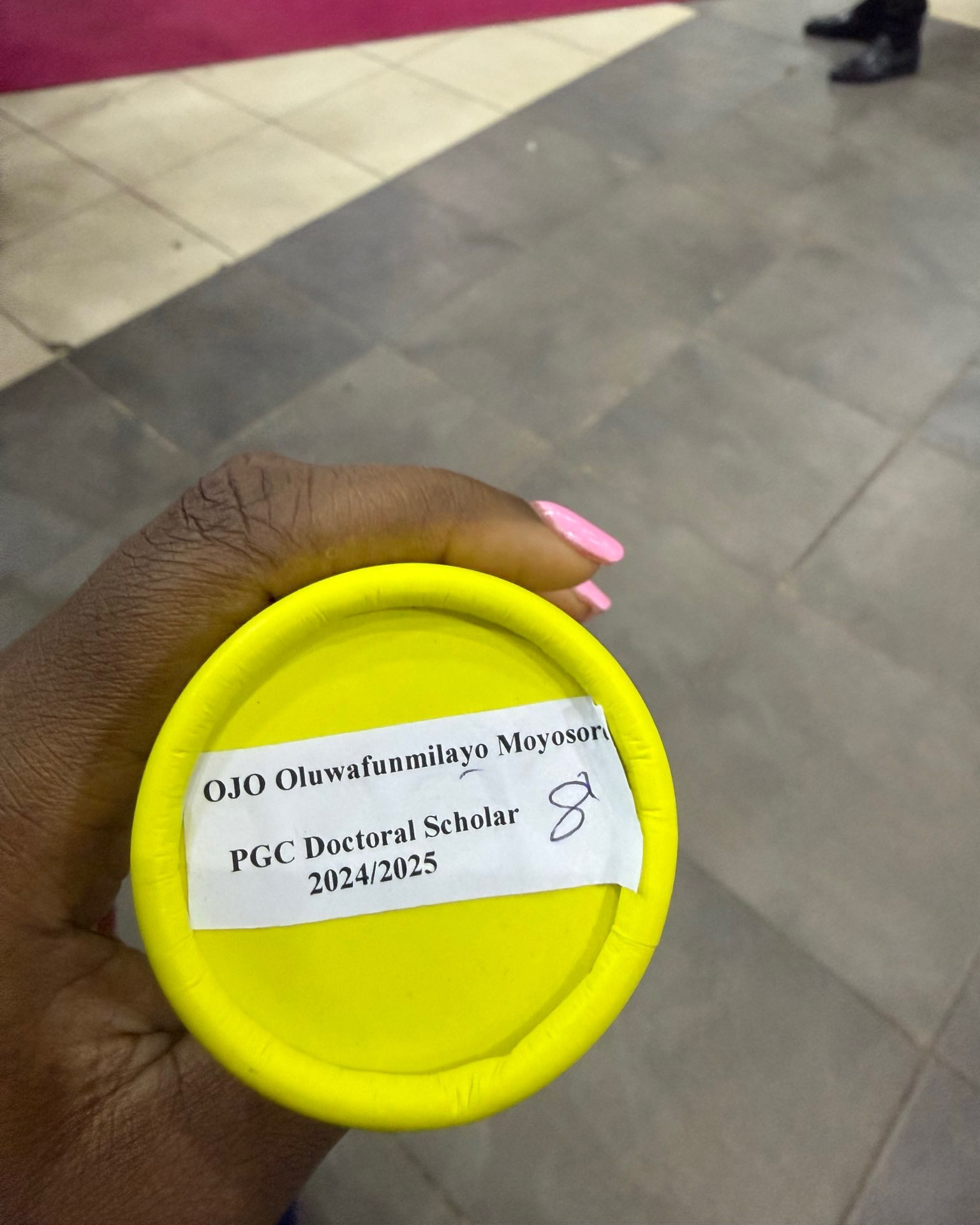
Funmi Ojo’s University of Ibadan Postgraduate College certificate scroll tube confirming her 2024/2025 PGC Doctoral Scholar award.
This is particularly important because I run a business, and work doesn’t simply stop because I have examinations. There are clients, production schedules, employees and other responsibilities to manage. So, I have to be deliberate about scheduling my working hours and creating dedicated time for studying. Ultimately, I don’t think having multiple responsibilities means everything else has to suffer. It’s about understanding your priorities, knowing when each one needs your attention and recognising when it’s time to temporarily pull back. For me, that period is usually the two or three weeks of examinations.
How did you handle the toughest courses or departmental hurdles that usually break a student’s GPA?
I studied Pharmacy, so there was quite a bit of mathematics and science involved. The funny thing is, I don’t particularly like mathematics. I love chemistry, manufacturing and production, but mathematics? Not so much! I already knew it wasn’t a subject that came naturally to me, so I made sure to give those courses extra attention. My auntie, who is a schoolteacher, always used to tell us that no subject is inherently difficult; sometimes, it’s simply a subject you haven’t read enough or don’t particularly enjoy. I’ve carried that mentality with me because I believe there’s very little you cannot learn if you’re willing to put in the time and effort.

Funmi Ojo celebrating her MSc graduation from the University of Ibadan with a 7.0/7.0 CGPA.
I think it’s important to identify your difficult courses early rather than spend all your time on subjects you’re already good at. Those challenging courses can make or break your CGPA, so you have to give them the attention they need. For me, that meant revisiting difficult topics, practising and reading until I understood them. I also think the lecturer’s teaching style matters. Attending classes helps you understand their expectations and how they approach examinations. Sometimes, you have to adjust your study methods to suit a particular course or lecturer. Ultimately, you cannot keep avoiding a subject because you don’t enjoy it. You have to identify what isn’t working, find another way to approach it and keep at it until you understand.
What habits, routines, or mindset helped you stay consistent throughout your university journey, and what practical advice would you pass on to students who hope to follow a similar path?
I wouldn’t say I’m the biggest stickler for habits and routines—I have ADHD, so sticking to rigid routines can be difficult for me. What has helped me most is my mindset and what I’ve internalised about education, hard work and my abilities. I believe that no subject is inherently too difficult and that you can understand almost anything if you’re willing to put in the work. I also believe education is one of the most accessible ways to improve your circumstances, especially if you don’t come from much.
I say this as someone who has built a business and experienced the demands of working in the real world. In many ways, reading hard is a little easier than working hard! Running a business comes with variables outside your control, from people and capital to customers and market conditions. With academics, the process is more straightforward: you have your books, learning materials and examinations, and a clearer idea of what you need to do to improve. You have to believe that education can take you places and that the effort you put in today can change the trajectory of your life.
Funmi Ojo, Best Graduating Student in the Department of Pharmaceutics and Industrial Pharmacy at the University of Ibadan.
My practical advice is to take every mark seriously, use AI as a learning tool, find ways to retain and communicate what you’ve learnt, and give difficult courses extra attention. When examinations come around, lock in and give them your best. Above all, don’t wait until you feel motivated or convince yourself that some people are simply born brilliant. Believe that what you’re working towards is worth the effort, because it is.
And I think if you can internalise that, develop the right approach to your studies and consistently put in the work, you’ll be just fine.
***
Photo Credit: Funmi Ojo